

Landfill leachate often gets grouped together with the generic term wastewater. There is nothing generic about landfill leachate. It is, as any reputable wastewater technology provider can tell you, a difficult liquid to manage.
Municipal wastewater as the name suggests comes from relatively well-understood sources and, while its composition varies, we generally know what to expect and how to treat it. This stream of wastewater is generally more dilute and predictable than landfill leachate. The sources include municipal sewerage and industrial wastewater sources discharged under some form of permit issued by the utility provider
Groundwater vs municipal wastewater vs landfill leachate:
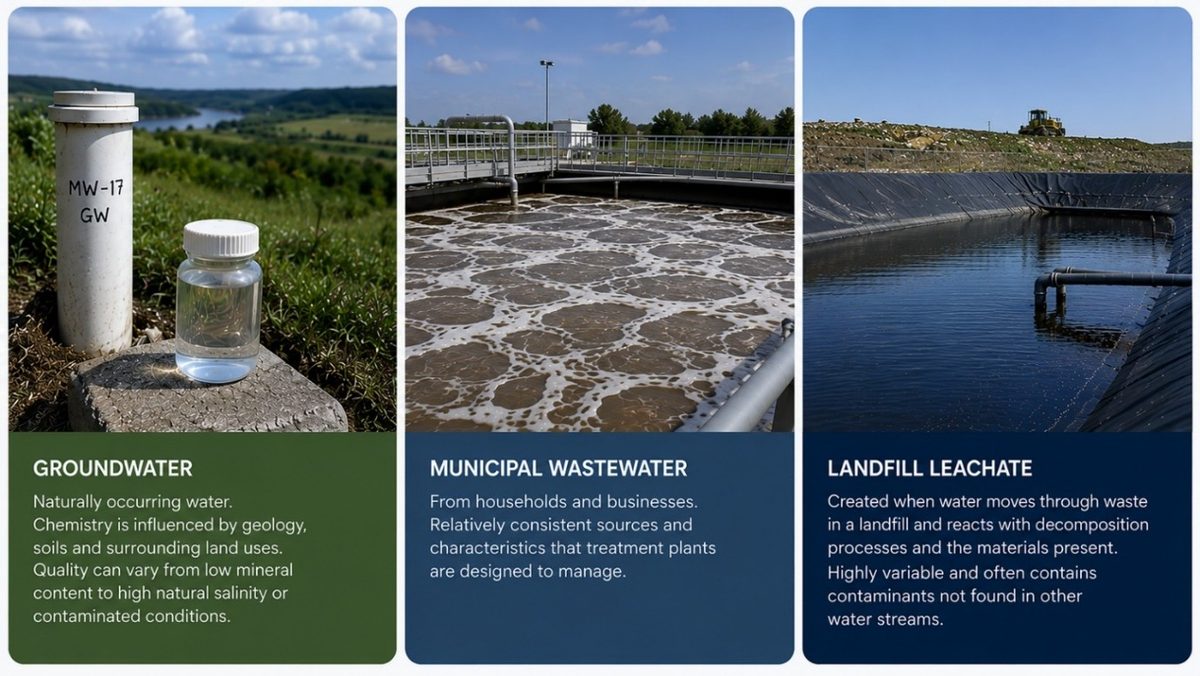
Leachate is different. It forms as water moves through waste within a landfill, picking up contaminants as the waste breaks down through the biological and chemical decomposition processes taking place.
The result can be a challenging mix of ammonia, dissolved salts, organic matter, alkalinity, metals and other contaminants, including PFAS and other persistent compounds. High total dissolved solids (TDS), conductivity, ammonia, chemical oxygen demand (COD) and chloride are common characteristics that can make leachate particularly difficult to treat.
And no two landfill leachates are the same. And no landfill’s leachate is consistent from week to week as different wastes decompose at different rates.
Leachate changes with the landfill
Leachate chemistry also changes over the life of a landfill.
Younger landfill leachate typically contains higher concentrations of readily biodegradable organic matter, reflected in higher BOD and COD. As the landfill matures, much of this material breaks down, and the BOD-to-COD ratio generally decreases. What remains is a greater proportion of refractory organic matter that is much harder to biologically degrade.
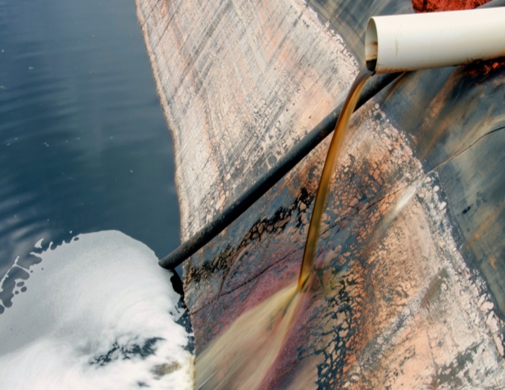
However, older leachate doesn’t necessarily mean it is easier to treat.
Ammonia can remain high for many years, while salts such as chloride don’t biologically degrade and can remain or become concentrated. Metals, PFAS and other persistent contaminants also need to be considered.
Rainfall, evaporation, waste composition, landfill operations and even individual cells can further change the chemistry.
In many ways, a leachate sample is a chemical snapshot of what is happening within a landfill at that point in its life.
Why is leachate difficult to treat?
It’s often the combination of contaminants that creates the challenge.
High ammonia can place significant demands on biological treatment. High salinity can affect biological processes and membrane performance. Calcium, magnesium and carbonate can contribute to scaling, while suspended solids and organic matter can cause fouling. Refractory organic compounds may also be poorly removed by conventional biological treatment. This means there isn’t one parameter that determines whether a technology will work. The overall leachate chemistry, and how it changes over time, matters. And, the volumes play a role too.
From a treatment technology perspective, the combination of characteristics means that typically you need a variety of technologies in sequence to treat each element of the matrix. A treatment train may include several processing steps. These trains can include biological systems as well as phyto remediation systems.
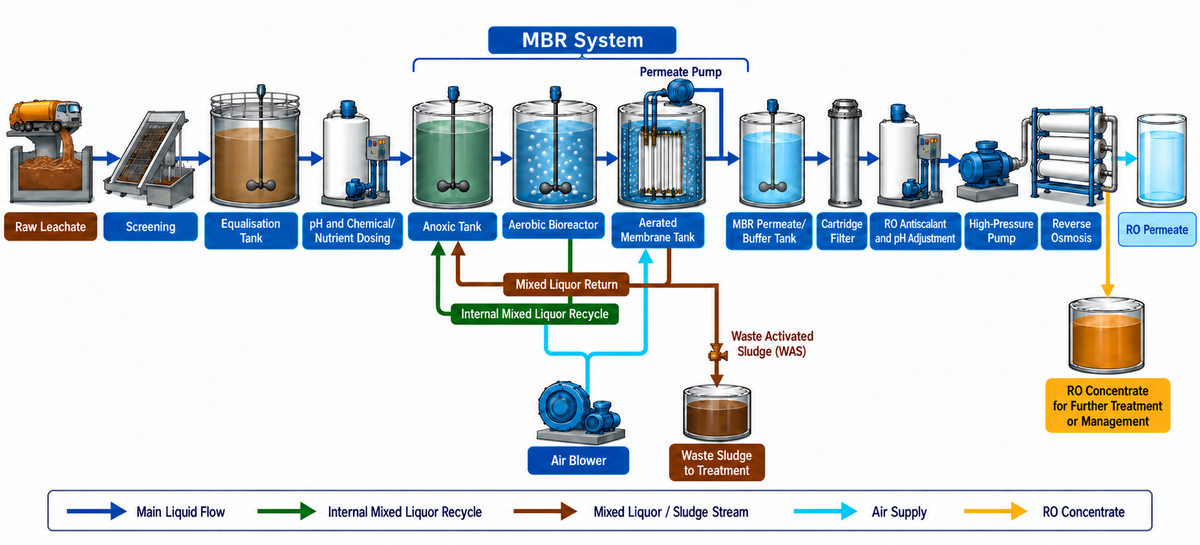
These multi-stage systems can require a substantial physical footprint to accommodate biological reactors, clarification tanks, membrane or filtration systems, chemical dosing equipment and sludge-processing infrastructure. Their performance may also depend on relatively stable influent chemistry, continuous operation and careful management of fouling, scaling, biomass health and residual streams.
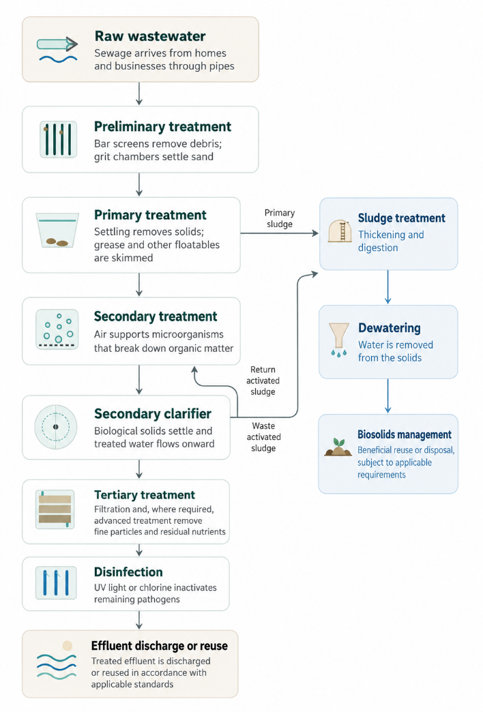
A process that performs well on municipal or industrial wastewater may behave very differently when exposed to landfill leachate containing high ammonia, high TDS, refractory COD and significant scaling potential.
Another aspect to consider when attempting to treat landfill leachate is understanding the end point or discharge regime. Depending upon what the destination for the treated leachate, there will be a list of contaminants that must be managed to comply with those permit thresholds. The required endpoint has a major influence on the complexity, footprint and cost of the treatment system. Meeting a stringent discharge standard may require several technologies operating in sequence such as the example here.
The difficulty is that landfill leachate chemistry does not remain constant. A treatment train designed around one set of analytical results may perform differently as rainfall, waste composition, landfill age or operations change. High ammonia can overload biological systems, high salinity can inhibit biomass and limit membrane recovery, and calcium, magnesium and carbonate can cause scaling. Suspended solids can clog and organic matter can foul filters and membranes, while refractory and persistent compounds may require further treatment.
It is this combination of a difficult and variable influent, strict endpoint requirements and multiple residual streams that causes problems for conventional wastewater treatment providers. The question is not simply whether a technology can treat wastewater; it is whether it can consistently manage the specific leachate chemistry, volumes and discharge requirements of the landfill.
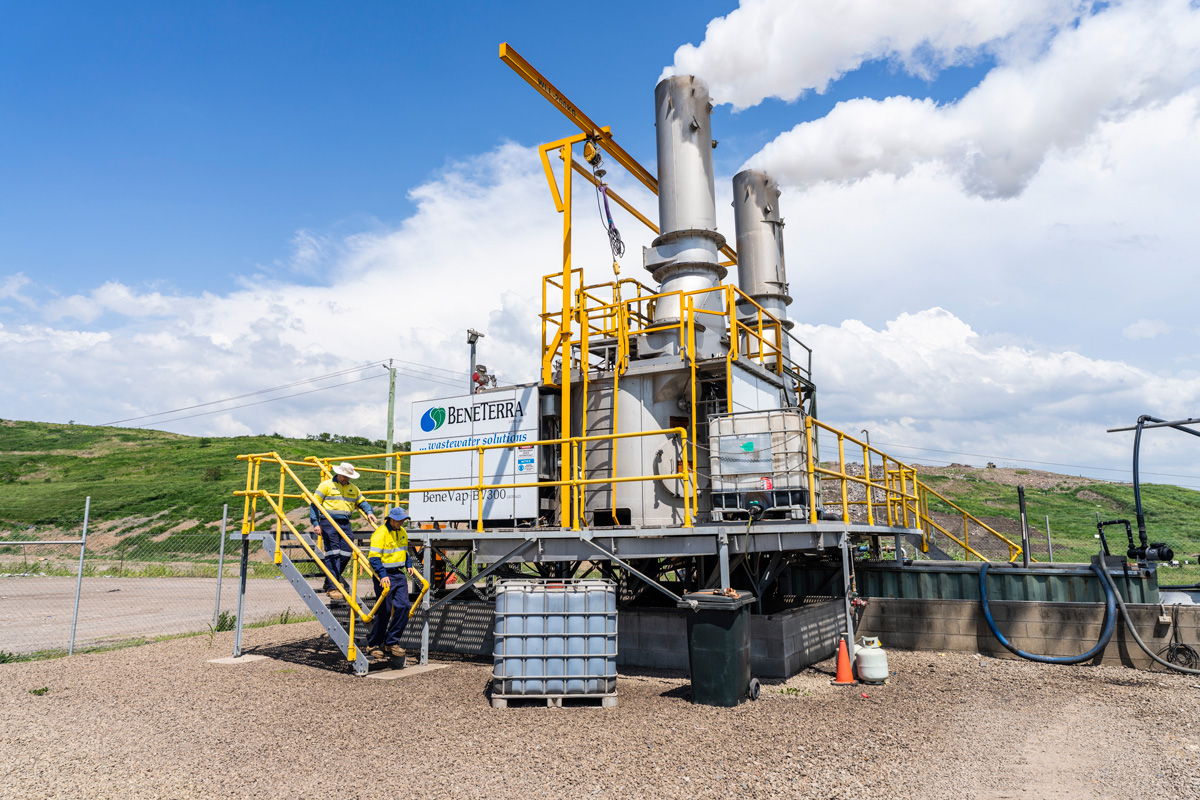
Where BeneVap fits
At many landfills, the immediate problem is not producing discharge-quality water. It is the volume of leachate accumulating onsite and the cost and logistics involved in storing, transporting or disposing of it.
BeneVap addresses that problem directly by reducing the volume of leachate that remains to be managed.
BeneVap does not rely on maintaining a biological population or forcing water through a membrane. This makes the process less sensitive to some of the biological inhibition, fouling and osmotic-pressure limitations that can affect conventional systems treating saline and variable leachate.
Where suitable landfill gas is available, it can be used as the primary fuel. This allows a resource already present at the landfill to support onsite leachate volume reduction.
Why experience matters
A technology may have a long track record treating municipal wastewater, industrial wastewater or contaminated groundwater. That’s useful experience, but it does not demonstrate how it will perform on landfill leachate. Ask any technology provider for their specific experience in landfill leachate – not just wastewater. Get references and war stories (we all have them in the waste industry) to verify performance issues.
A system proven on wastewater with relatively low salinity and readily biodegradable COD may behave very differently when exposed to leachate containing high ammonia, high TDS, refractory COD and significant scaling potential.
BeneTerra has been dealing with various wastewaters over the past several decades. Treatment and disposal systems in the municipal waste sector, treatment and irrigation systems in the oil and gas sector, and leachate management technologies at landfills. BeneTerra has treated more than 500 million litres of landfill leachate across Australia, New Zealand and the United States. Each landfill has presented its own chemistry, operating conditions and practical challenges. There are several war stories as each landfill presents its own unique challenges.
So, when assessing a technology, look at the influent chemistry, landfill age, operating history, treatment performance and any residual streams produced. Most importantly, ask whether those conditions are comparable to your site.
There is no miracle one stop treatment technology that works in every situation. Your site’s characteristics matter.
When the challenge is landfill leachate, there is no substitute for landfill leachate experience.